
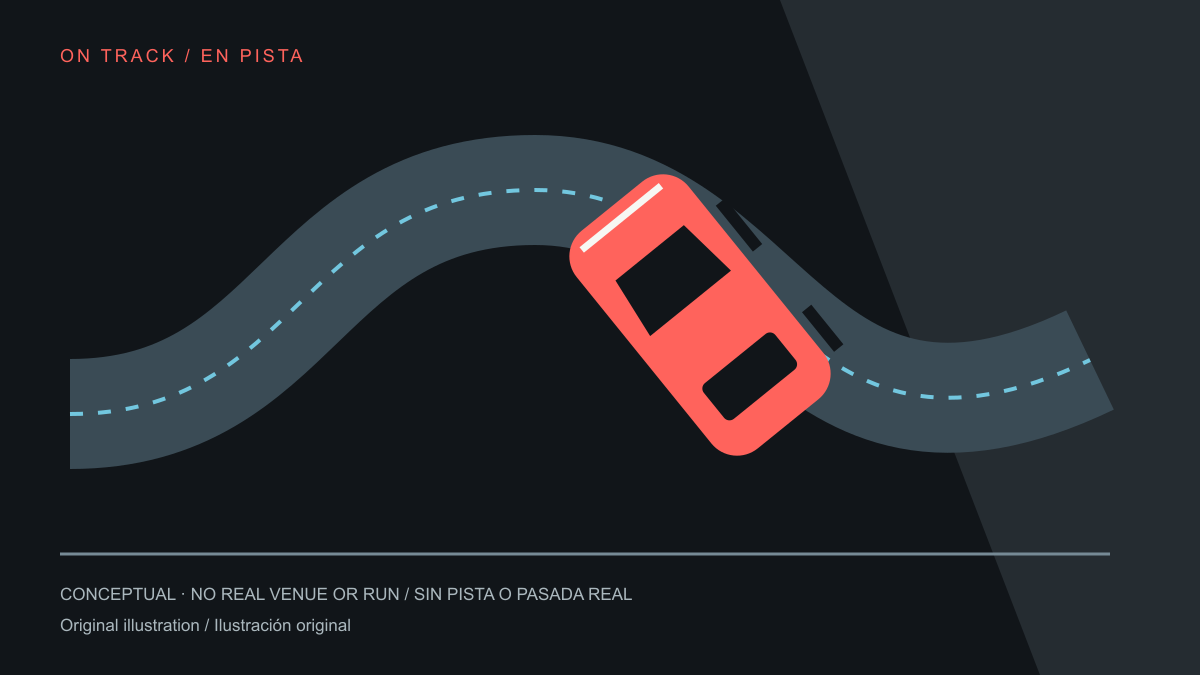
Follow three things: where the car travels, where its body points and when it changes direction. Watch each one on a separate replay. You will have a clearer description of the run, plus better questions for the people who know its context.
Check what kind of session you are watching
Look for the organizer's description: practice, demonstration, qualifying or a tandem battle. A short social clip may not tell you which one it shows. Check its original caption, event information and session description before interpreting it.
Start with an observation you can support: “The car moves across the frame,” for example. Save questions about a score or a competition result until you have the applicable rules and official decision. A striking moment alone cannot supply that context.
Separate path from heading
The path is where the car travels. Its heading is where the body points. Those directions can visibly differ during a drift. Keep them separate when describing a replay: a car's position in the picture and the direction its body faces answer different questions.
In Formula DRIFT's 2026 rulebook, line is the course route explained by the judges. Its tandem criteria ask the chase car to match or improve the lead car's angle and follow its line and transitions. Those are series-specific expectations, not instructions for scoring an unidentified clip. Formula DRIFT: section 5.1 and glossary.

Use this original sketch as a viewing prompt. It represents no venue and offers no driving line to copy. Compare its three panels with what you can actually see in a clip; do not treat its illustrative path as the organizer's course plan.
Give each replay one job
On the first replay, follow the route across the frame. Identify a place where the car enters the picture and a place where it leaves. You are describing the camera's view, not measuring the course.
On the second replay, watch the direction the body points. Notice a moment when you can distinguish it from the direction of travel. If the camera angle hides the relationship, leave that part unanswered.
On the third replay, watch a change of direction. Can you follow it continuously, or does an edit interrupt the view? Write one sentence about what you saw and one question about what you could not see. That is the whole exercise; you do not need to produce a score.
For two cars, choose one to follow on each replay. Notice when their movements appear to match and where you lose sight of either car. Use “lead” and “chase” only when the session context identifies those roles. A close-looking chase still needs that context before it becomes evidence for a judging claim.
Rules belong to a series and a session
In Drift Masters' 2026 qualifying rules, style is divided into initiation, fluidity and commitment. Its fluidity description includes controlled transitions and a settled car. Use those terms to understand that series' explanation; another organizer must supply its own criteria. Drift Masters: sections 1.6 and 1.7.
If results matter, find the complete session context and official decision. Keep what you observed separate from the explanation you are still seeking. A cloud of smoke, an edit or an exciting camera angle leaves plenty of room for unanswered questions.
Bring one useful question
Try asking an identified driver or organizer: “Where should a first-time fan look at this moment?” Point to the part of the clip you mean. Your three replays give you a concrete starting point: a place, an orientation or a change you want to understand.
Keep that question for the next run you watch. You can return to the same exercise whenever a new course, camera view or session format makes the action difficult to follow.
Sources and context
The linked rules were checked on November 4, 2026. They provide dated examples of competition vocabulary; the applicable organizer's current rules and briefing remain the references for a particular event.